
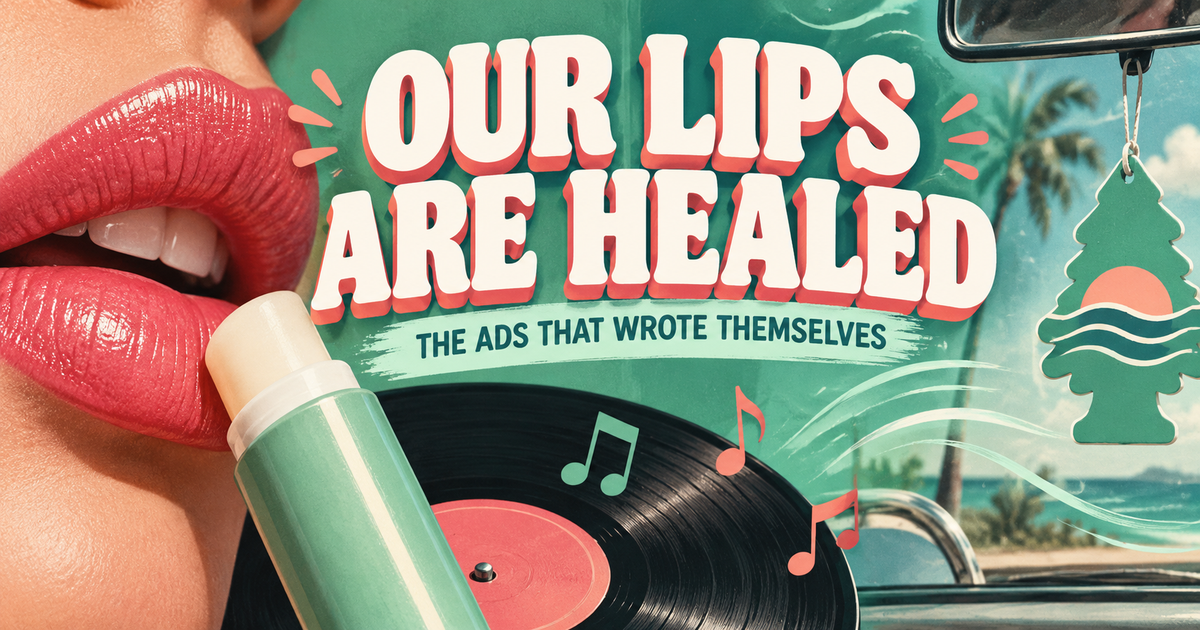
Our Lips Are Healed: The Ad Campaigns That Wrote Themselves
ChapStick has the Go-Go’s. Febreze has Seals and Crofts. So why are advertising agencies still pitching “Lip Forward™” instead of campaigns that write themselves?
Jump to a section
I would like to file a formal complaint against the advertising industry.
Not because ads are intrusive. Not because they track us across the internet like a private investigator with a coupon code. Not even because every company now seems convinced that I need to develop an emotional relationship with its dishwasher detergent.
Today I have a much narrower charge.
Advertising agencies are apparently incapable of recognizing an idea when the product and a famous song are standing next to each other, pointing at one another, and yelling the campaign at them.
Exhibit A: ChapStick
The Go-Go’s released Our Lips Are Sealed in 1981. If you need the song in your head before the argument can proceed, there it is.
ChapStick makes a product you put on damaged lips so they will heal.
I am going to give the advertising industry a moment to finish whatever 73-slide brand strategy presentation it is currently sitting through.
Ready?
OUR LIPS ARE HEALED.
That is it. That is the campaign.
You do not need an ideation sprint. You do not need a consumer-insight workshop. You do not need twelve people in a glass conference room moving pastel sticky notes between columns labeled AUTHENTICITY and CONNECTION.
You need one person to notice that sealed and healed rhyme.
The commercial is essentially already storyboarded. Someone has miserable dry lips. ChapStick goes on. The song kicks in. Suddenly the entire emotional arc of the product has been communicated by changing one word.
Then the logo appears:
CHAPSTICK
OUR LIPS ARE HEALED.
Everybody goes home early.
Instead, somewhere in the world, I assume a creative director is presenting a campaign called something like Unlock Your Lip Potential while a strategist explains that modern consumers are seeking “restorative mouth-area wellness experiences.”
Guys. It is ChapStick.
Heal the lips.
Exhibit B: Febreze
Now we move to Febreze, a product whose entire job is making the air around you smell better.
There is a massively recognizable 1972 song by Seals & Crofts called Summer Breeze.
I am once again asking the advertising industry to assemble the clues.
Breeze.
Fresh air.
Nice smell.
Febreze.
“Febreze makes me feel fine.”
You already know what melody that goes to.

How is this not sitting in a campaign folder somewhere with seventeen seasonal variations?
Febreze Summer Breeze. Curtains moving through an open window. Fresh sheets. A couch that no longer smells like three dogs and a teenager live on it. The product sprays. The music lands. Done.
The brand does not even need to explain the creative brief because Summer Breeze is the creative brief.
Yet I fully expect that an actual agency pitch would instead give us a slow-motion family walking into a beige living room while text appears on screen saying:
FRESHNESS, REIMAGINED.
Then somebody invoices Procter & Gamble for discovering the concept of air.
Update: More Campaigns Just Fell Into My Lap
Apparently these ideas breed when nobody is watching. I finished the original complaint, and then more of them just started showing up. I have not audited every commercial ever made. That would be billable.
Shout stain remover + “Shout” by Tears for Fears. Shout, shout, get the stain out. That is the entire campaign. Please do not convene a workshop to discover the emotional significance of laundry.

Ring Video Doorbell + “Who Can It Be Now?” by Men at Work. Doorbell rings. Saxophone starts. Phone shows who's there. We are finished before the first person in the meeting says “consumer journey.”
Verizon + “Words” by Missing Persons. “Do you hear me?” Verizon built an entire campaign around “Can you hear me now?” Missing Persons had already supplied the musical version. Dale Bozzio asks the question. The guy with the glasses answers. Put the logo up and send everyone home. We have just canceled a three-hour workshop on Audible Human Connection. Save “Do you care?” for the customer-service hold music.
Phone companies, bell manufacturers + “Ring My Bell” by Anita Ward. Any phone company could have this. So could somebody whose actual job is manufacturing actual bells. I would particularly like to see a bell manufacturer spend its entire annual advertising budget licensing a disco song.
Away carry-on luggage + “Carry On Wayward Son” by Kansas. Carry-on. Wayward Son. Someone puts a bag in an overhead bin. Cue Kansas. Somewhere, a creative team has spent six weeks naming this experience “Elevated Travel.”
Wolf Brand Chili + “Hungry Like the Wolf” by Duran Duran. Hungry. Wolf. Chili. There are only three clues, and two of them are in the brand name. Please put the focus-group moderator down.
Instant Pot + “Under Pressure” by Queen and David Bowie. A pressure cooker. A bass line. Dinner. An entire kitchen campaign has just appeared, and nobody had to use the phrase “mealtime innovation ecosystem.”
Gorilla Glue + “Never Tear Us Apart” by INXS. A broken mug. A reunion. A soaring love song. Suddenly a glue commercial is more emotionally committed to this relationship than either person on a dating show.
3M Command Strips + “You Keep Me Hangin’ On” by the Supremes. The picture is hanging on. It's right there in the song. We can have the commercial done before the wall is dry.
3M Command Strips, again + “Don’t Let Me Down” by the Beatles. Another entire campaign, same adhesive. Put up a picture. Look at the picture. Look nervously at the picture. The Beatles take it from there.

Tide detergent + “The Tide Is High” by Blondie. The Tide is high. So is the laundry pile. We have now reached a point where the product name and the song title can practically introduce themselves.
Laundry detergent + “Every Breath You Take” by The Police. “I'll be watching you” becomes “I'll be washing you.” One word. That is the entire rewrite. A detergent bottle watches from the shelf as someone drops a filthy shirt into the hamper. It has been waiting for this moment. The original song is already a little unsettling, so naturally the advertising industry can call this campaign Always-On Fabric Relationships.
Lotrimin or Vagisil + “Ring of Fire” by Johnny Cash. I am not going to storyboard this one. If the title and the product category have not already produced an image in your mind, congratulations on your innocence. There is also an actual historical footnote here: advertisers proposed the song for hemorrhoid relief in 2004, and Cash's family objected. So somebody did make the phone call. Respect.
Every dentist's office + “Feels So Good” by Chuck Mangione. This song has been playing in dental waiting rooms for decades. The patient takes a seat, the flugelhorn starts, and someone approaches holding a clipboard and several deeply personal insurance questions. The campaign has apparently been running without a contract.

I could keep going, but the advertising industry has already received enough free work for one article.
What Are You People Doing in Those Meetings?
This is the part that bothers me.
Advertising agencies have developed an entire professional vocabulary for explaining why obvious ideas require enormous amounts of money.
There are brand platforms. Cultural insights. Consumer truths. Sonic identities. Emotional territories. Audience journeys. Activation strategies. Omnichannel ecosystems. Cross-generational resonance.
All of which is fine. Sometimes complicated products require complicated thinking.
But if your client sells ChapStick and nobody in the room says “Our Lips Are Healed,” I would like to know what the snacks were like at the meeting, because apparently that was where everybody’s attention went.
I can picture the deck now:
CONSUMER TRUTH: People prefer when their lips do not hurt.
BRAND PURPOSE: Helping lips become less bad.
CREATIVE TERRITORY: Restoration.
CAMPAIGN PLATFORM: Lip Forward™
Outstanding. Put a gradient behind it and bill another forty hours.

Yes, I Know Music Licensing Exists
At this point somebody from advertising will explain music rights to me.
Yes. I know.
Songs have publishers. Recordings have owners. Lyrics have rights. Famous music costs money. Rewriting lyrics can require additional approval. Deals can fail.
That is not a defense of the advertising industry. That is a description of the advertising industry’s job.
You are the people with the client, the budget, the lawyers, the music supervisors, and the ability to make the phone call.
If the rights holder says no, fine. Now you have a story about the excellent campaign you tried to make.
But I refuse to accept “licensing is complicated” as the reason we should instead endure Freshness Starts With You™ for the next six months.
A Modest Proposal
ChapStick, call whoever needs to be called about Our Lips Are Sealed.
Febreze, make the Summer Breeze call.
If the answer is no, at least civilization will know that somebody tried.
And advertising agencies, I say this with all the affection due to an industry that can spend six figures naming a shade of blue:
Please stop trying to invent “cultural moments” long enough to notice the ones that have been sitting on the radio for fifty years.
There are probably dozens more of these.
Your turn: What painfully obvious song-and-product pairing am I missing? Share this with the friend who will immediately think of something worse. And if either of these campaigns actually aired, send me the evidence. I will issue a correction and adjust my invoice accordingly.
Unfortunately, I have now realized that finding them is apparently a marketable professional skill.
So the free consulting portion of this article has concluded.
My agency rates begin immediately.
More topics and Minty publications
More oddly specific things worth reading
Get more humor, pop-culture rabbit holes, and curious finds from Minty, plus occasional shop news. Unsubscribe anytime.
Follow this publication by RSS
Prefer a feed reader? Get new stories without an account.